AVE REGINA CAELORUM – ORGAN RECITAL BY ALEN KOPUNOVIĆ LEGETIN IN HONOUR OF MARY
14.08.2026
Hail, O Queen, Mother of Mercy,
our life, our sweetness and our hope, hail.
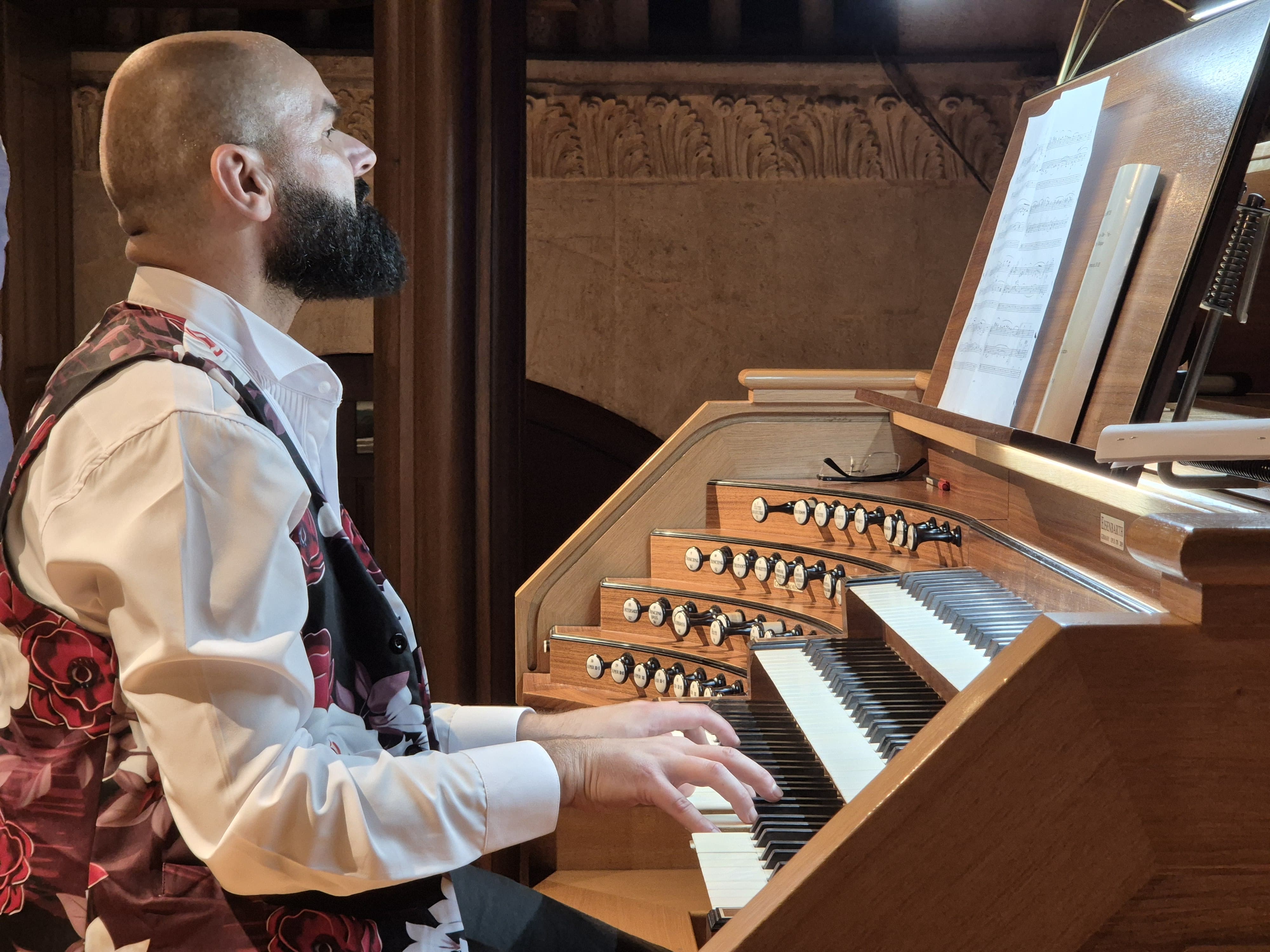
On 14 August 2026 at 8:00 p.m., on the eve of the Feast of the Assumption of the Blessed Virgin Mary, the organ recital “Ave Regina Caelorum” was held at the Cathedral of St. Anastasia in Zadar. The recital, performed by distinguished Croatian organist Alen Kopunović Legetin, was part of the Third International Organ Festival Organs of St. Anastasia.
The concert was dedicated to the Queen of Heaven and to the Feast of the Assumption of the Blessed Virgin Mary. Its programme was conceived as a Marian spiritual and musical meditation spanning several centuries of European organ literature, from the Baroque to the late Romantic period and early modernism.
The programme opened with Bach’s Fuga sopra il Magnificat BWV 733, establishing the liturgical and Marian foundation of the recital. The works of French composers that followed brought a rich variety of organ colours and styles. Dandrieu’s Suite I. Magnificat presented the characteristic French Classical organ style through the movements Plein Jeu, Duo, Trio, Basse de Trompète, Flûtes and Dialogue.
In the works of Marcel Dupré, Alexandre Guilmant and Henri Dallier, the Marian theme continued through different expressions of the late-Romantic and symphonic organ tradition. Dupré’s Antiphon Nigra sum sed formosa op. 18 No. 3, inspired by the Song of Songs, held a particularly important place, while Guilmant’s Ave Maria op. 65 No. 4 brought an intensely lyrical and prayerful character. Dallier’s Electa ut sol opened a world of richer, more colourful and symphonic sonorities.
Liszt’s Ave Maria von Arcadelt provided a moment of particular contemplation and simplicity. In this work, Liszt enriches a Renaissance melody with a refined harmonic language, creating an atmosphere of quiet prayer.
The central and most demanding part of the programme consisted of three movements from Paul de Maleingreau’s triptych L’Annonciation – La Visitation – La Glorification. Gregorian inspiration, modality, Impressionistic harmonies and powerful symphonic architecture are brought together in these works. L’Annonciation evokes an atmosphere of mystery, La Visitation brings movement and inner joy, while La Glorification reaches a monumental sonic climax.
The recital concluded with Mozart’s Fantasia and Fugue in F minor, K. 608, one of the best-known and most demanding works in the organ repertoire. The Fantasia and Fugue brought together dramatic power, the clarity of Classical form and contrapuntal discipline, making Mozart’s masterpiece a powerful conclusion to the entire programme.
The programme as a whole formed a kind of Marian sonic cathedral, in which Gregorian inspiration, French registrational richness, German counterpoint, Liszt’s mysticism and the symphonic grandeur of the late Romantic period came together.
The particular strength of the recital lay in its dramaturgical coherence. The different styles and periods did not appear as separate entities, but rather as parts of a unified musical meditation dedicated to the Blessed Virgin Mary.
In celebrating Mary’s Assumption into Heaven, the Church celebrates not only what God accomplished in Mary, but also the promise given to every human being – the hope of resurrection and ultimate union with God. Within this spiritual framework, the recital “Ave Regina Caelorum” became a musical tribute to the Queen of Heaven and a moment of shared prayer through the beauty of organ music.
Programme
J. S. Bach
Fuga sopra il Magnificat BWV 733
J. F. Dandrieu
Suite I. Magnificat – Plein Jeu – Duo – Trio – Basse de Trompète – Flûtes – Dialogue
M. Dupré
Antiphon Nigra sum sed formosa op. 18 No. 3
A. Guilmant
Ave Maria op. 65 No. 4
H. Dallier
Electa ut sol
F. Liszt
Ave Maria von Arcadelt
Paul de Maleingreau
op. 65 – L’Annonciation – La Visitation – La Glorification
W. A. Mozart
Fantasia and Fugue in F minor, K. 608
ALEN KOPUNOVIĆ LEGETIN - BIOGRAPHY
Alen Kopunović Legetin (born in Subotica on 29 October 1974) is a Croatian organist, choir conductor, composer, educator, and promoter of sacred and concert music. Throughout his distinguished career, he has established a recognizable and respected artistic profile on both the Croatian and international music scenes. His work encompasses concert organ performance, liturgical music, composition, teaching, and the artistic direction of various musical ensembles and projects. At the heart of his artistic activity lies the organ—an instrument that, in his approach, becomes a medium for profound musical, spiritual, and aesthetic expression.
Alen Kopunović Legetin holds a distinctive position in the Croatian musical landscape as an organist, choir conductor, composer, and advocate of sacred and concert music. His artistic identity has been shaped by a synthesis of discipline, emotional depth, spirituality, and a commitment to the highest artistic standards. This unique combination has resulted in an interpretative style that both respects tradition and seeks an authentic personal artistic voice. As an organist, he is renowned for his monumental sound, compelling interpretative dramaturgy, and his ability to communicate complex musical works to a broad audience without compromising their artistic integrity.
Musical Education
He received his primary and secondary music education in Subotica, graduating from the Music School with majors in music theory and piano. He continued his organ studies at the Academy of Music, University of Zagreb, where he graduated in 1997 in the organ class of Ljerka Očić. During his studies, he served as organist at the Church of the Minor Seminary on Šalata and at St. Mark's Church in Zagreb, where he gained valuable experience in both liturgical and concert performance. In recognition of his artistic achievements, he was awarded the Rector's Award of the University of Zagreb. He continued his education in an international environment. During the 1998/1999 academic year, he pursued advanced studies at the Mozarteum University Salzburg under Elisabeth Ullmann, and further specialized in sacred music at the Pontifical Institute of Sacred Music in Rome, where he studied with Fr. Theo Flury.
Liturgical and Educational Activities
From 1999 to 2016, Alen Kopunović Legetin served as organist and choir director of St. Lawrence Church in Požega, while also holding the position of Pontifical Organist of the Diocese of Požega. During this period, he made a significant contribution to the development of the musical life of both the city of Požega and the diocese. He was conductor of the Croatian Cultural and Artistic Society Vijenac in Požega, Artistic Director of the Požega Organ Evenings Festival, and a faculty member at the Požega Music School, where he taught organ, choir, and piano. From 2017 to 2020, he served as organist and choir director at the Parish of the Annunciation of the Lord in Zagreb. From 2023 to 2025, he held the same position at the Parish of St. Maximilian Kolbe in Zagreb. Teaching has always occupied an important place in his artistic career. As a professor and mentor, he has educated and inspired new generations of musicians, passing on his knowledge, experience, and commitment to the highest artistic and aesthetic standards.
Concert Career
As a concert organist, Alen Kopunović Legetin has built an extensive solo and chamber music career. He performs regularly throughout Croatia and across Europe and has appeared as a soloist with ensembles including the Zadar Chamber Orchestra, the Croatian Radiotelevision Symphony Orchestra, the Varaždin Chamber Orchestra, the Croatian Armed Forces Symphony Orchestra, and the Dubrovnik Symphony Orchestra. He has performed in numerous concert halls, cathedrals, and basilicas throughout Europe, including St. Peter's Basilica in Rome, the cathedrals of Munich, Budapest, Kotor, Belgrade, and Subotica, as well as St David's Hall in Wales. He has appeared at many prestigious festivals, including the Musical Evenings at St. Donatus, Rab Musical Evenings, Osor Musical Evenings, Makarska Cultural Summer, Ars Organi Sisciae, Organum Histriae, Požega Organ Evenings, and the Varaždin Baroque Evenings. He is also a regular guest artist at the International St. Anastasia Organ Festival in Zadar.
Chamber Music and Ensemble Work
Alongside his solo career, he is actively engaged in chamber music. He is a member of the Fiat Lux Trio, together with soprano Josip Lončar and trumpeter Dario Tešker. He directs the male vocal quartet Adore and performs in the organ duo Voluntas with organist Davor Ljubić.
He has also collaborated with several vocal ensembles and the Croatian a cappella groups Stine and Leggero. Earlier in his career, he served as Artistic Director of the vocal-instrumental ensemble Capella Lignum and the Sancta Barbara Festival of Wooden Chapels.
Compositional Work
As a composer, Alen Kopunović Legetin is primarily devoted to sacred and liturgical music. His catalogue includes Mass settings, motets, psalm settings, litanies, works for choir, solo voice and organ, as well as numerous arrangements of liturgical and traditional sacred melodies. His compositions are distinguished by their successful balance between liturgical functionality and artistic expression. Melodic clarity, solid harmonic structure, and a profound spiritual atmosphere form the foundation of his compositional language, resulting in music that is both accessible and artistically compelling.
Discography
Alen Kopunović Legetin's discography includes several notable recordings. Among the most significant are Portrait of the Queen (Portret kraljice), released by Croatia Records; Croatian Musical Baroque, recorded during the Varaždin Baroque Evenings in collaboration with the renowned mezzo-soprano Dunja Vejzović; Cantantibus Organis, recorded on the historic organ of the Cathedral of St. Teresa of Ávila in Požega; and his more recent albums Leggero and Magnificat.
He is a member of the Croatian Association of Music Artists.
Artistic Identity
What distinguishes Alen Kopunović Legetin above all is his strong artistic authenticity. His performances combine technical mastery with emotional openness, allowing virtuosity to serve expression rather than overshadow it. His interpretative approach is characterized by meticulous preparation and an in-depth exploration of the historical, stylistic, and spiritual context of each work. For him, music is not merely sound, but a vehicle for ideas, spiritual meaning, and cultural heritage. His performances are often marked by striking contrasts—from moments of almost ascetic silence to the full grandeur of the organ's monumental sonority—creating interpretations of exceptional dramatic power and emotional depth.
Distinctive Artistic Qualities
Several qualities distinguish Alen Kopunović Legetin as an organist, choir director, and musician:
Artistic authenticity – He remains faithful to his own musical convictions and interpretative vision rather than adapting to trends or audience expectations.
A rare balance of discipline and expressiveness – His performances unite rigorous musical precision with profound emotional intensity.
A deeply rooted spiritual identity – His work as both performer and composer reflects a profound understanding of the spiritual dimension of sacred music, allowing faith and artistry to enrich one another naturally.
As a performer, composer, educator, and advocate of organ music, Alen Kopunović Legetin has made a lasting contribution to the development and promotion of organ culture in Croatia. His artistic journey reflects an unwavering dedication to music, a profound commitment to the organ as an instrument of monumental expressive power, and a belief in music as a space where artistic excellence, spirituality, and cultural heritage meet.


