Raphael Attila Vogl – An Outstanding Evening of Organ Music at St. Anastasia’s Cathedral
24.07.2026
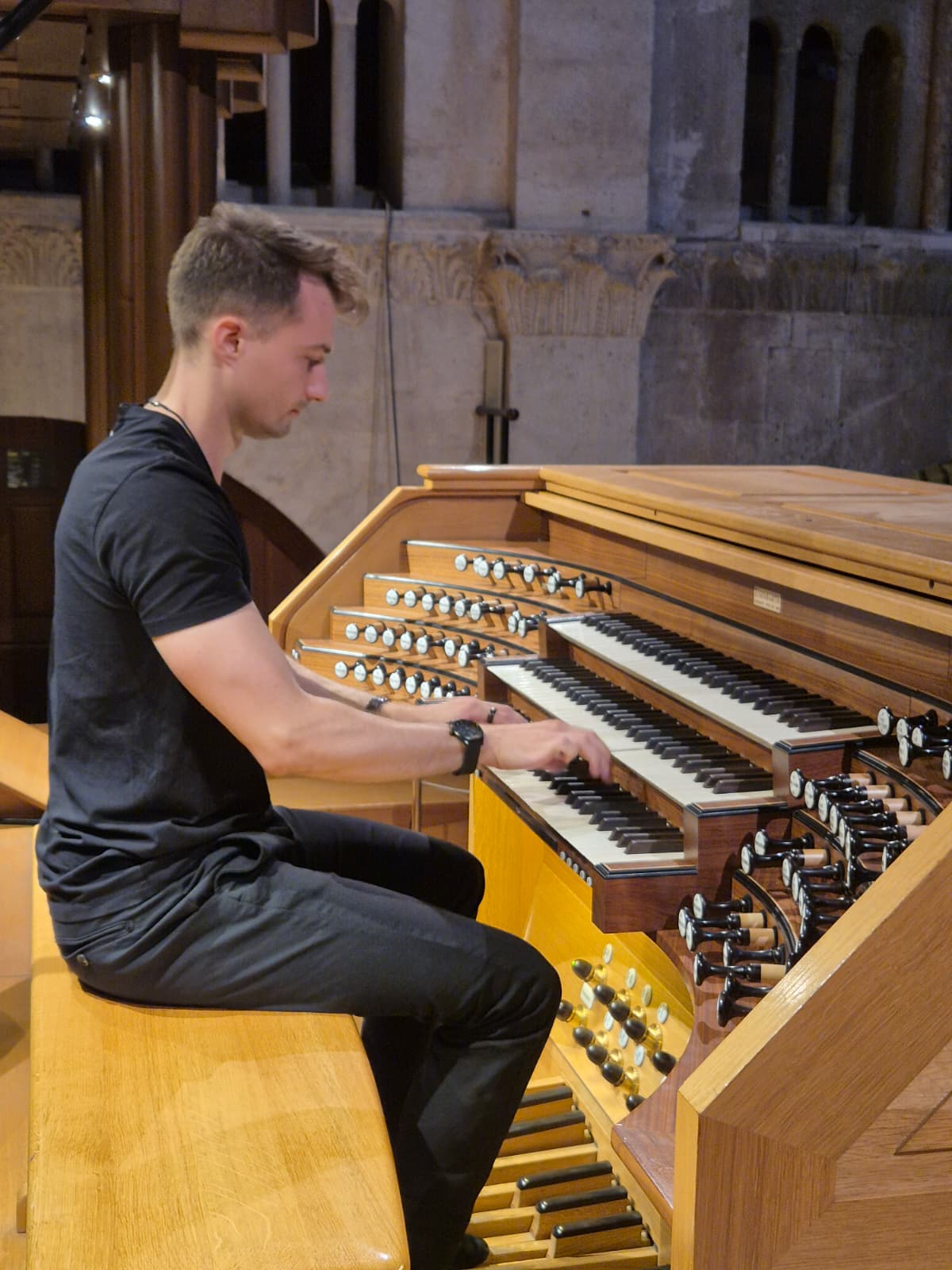
"Vogl is a brilliant young organist who possesses copious facility, creative imagination, and muscial passion."
The American Organist
https://www.raphaelattilavogl.com/
The fourth concert of the 3rd International St. Anastasia Organ Festival, held on Friday, 24 July 2026 at St. Anastasia’s Cathedral in Zadar, brought the audience another exceptional musical evening. Following his successful debut last year, German organist Dr. Raphael Attila Vogl returned before the Zadar audience and once again confirmed why he is considered one of the most distinguished young organists of his generation.
A Return of the Artist Connecting Passau and Zadar
The return of the artist carried a special symbolic meaning, as he was born in Passau, the city where the renowned Eisenbarth organ workshop, builder of the monumental organ of Zadar Cathedral, originates. Thus, an artist from the very same city once again performed on an instrument with the same heritage, creating a unique connection between Passau and Zadar.
From Passau to Juilliard – The Journey of a Young Organist with an International Career
German organist Dr. Raphael Attila Vogl began his musical education in his hometown of Passau under the guidance of Cathedral Organist Ludwig Ruckdeschel. He completed his studies in organ and church music in Regensburg with Stefan Baier and Markus Rupprecht, and later continued his studies at the prestigious Franz Liszt Academy of Music in Budapest in the class of László Fassang. In 2020, he earned his Master’s degree in Organ Performance at the renowned The Juilliard School in New York, studying with Grammy Award-winning organist Paul Jacobs. In 2026, he earned the academic degree of Doctor of Musical Arts (DMA) in Organ Performance. He is the recipient of numerous international awards and performs in leading concert halls and cathedrals throughout Europe and the United States, collaborating with renowned orchestras, philharmonic ensembles, and conductors.
Music Without a Score – A Unique Concert Experience
From the very first notes, it was clear that the audience was about to experience an extraordinary concert. Dr. Raphael Attila Vogl performed the entire programme from memory, without a single page of sheet music before him, which impressed the audience and further highlighted his exceptional musicianship, concentration, and artistic confidence. A special feature of the concert was the opportunity for the audience to follow Raphael’s performance on a large screen while listening to the music. The camera faithfully captured every movement of his hands and feet, allowing visitors to experience from close range the complexity of organ technique and the virtuosity of his interpretation. This combination of sound and image brought the art of organ performance closer to a wider audience.
From Great Orchestral Works to Improvisation
The first part of the programme consisted of transcriptions of great orchestral works arranged for organ by Raphael Attila Vogl himself, and before the final improvisation he gave a brilliant performance of Variations on a Theme of Paganini.
The concert opened with an impressive transcription of Felix Mendelssohn Bartholdy’s Overture to “A Midsummer Night’s Dream”. This opening work immediately demonstrated the full richness of the symphonic sound of the great organ of St. Anastasia’s Cathedral and Vogl’s ability to transfer the colours of an orchestra onto a single instrument.
This was followed by his transcription of Johann Sebastian Bach’s Brandenburg Concerto No. 3 in G major, in which he displayed exceptional clarity of polyphony, rhythmic precision, and virtuosity throughout its three movements. A particularly atmospheric moment was created by Claude Debussy’s “La cathédrale engloutie” (The Sunken Cathedral), where the richness of registration and expressive possibilities of the organ evoked the impressive soundscapes of French Impressionism.
Paganini Variations and Improvisation
One of the most memorable moments of the evening was George Thalben-Ball’s Variations on a Theme of Paganini. The performance captivated the audience, and the demanding pedal variation left a particularly strong impression, performed by Vogl with remarkable ease, precision, and confidence. The concert concluded with an improvisation by Raphael Attila Vogl, once again demonstrating his creativity, imagination, and ability to create music spontaneously. The freedom of musical expression and richness of ideas brought this special evening to a magnificent conclusion.
The End of the Evening with a Bach Encore
At the end of the concert, the numerous audience members expressed their appreciation with prolonged applause for the artist’s exceptional performance. As a gesture of gratitude, Dr. Raphael Attila Vogl returned to the organ and performed Johann Sebastian Bach’s Sinfonia from Cantata No. 29 as an encore, bringing his second concert in Zadar to a memorable close.
Concert Programme
The programme performed by Dr. Raphael Attila Vogl at St. Anastasia’s Cathedral on Friday, 24 July 2026, at 8:00 p.m.:
Felix Mendelssohn Bartholdy (1809 – 1847)
Overture on A Midsummer Night's Dream,op.21
(Transcription Raphael A. Vogl)
Johann Sebastian Bach (1685 – 1750)
Brandenburg Concerto No. 3 in G Major, BWV 1048
(Transcription Raphael A. Vogl)
- Allegro con spirito
- Adagio
- Allegro
Claude Debussy (1862 – 1918)
La cathédrale engloutie
(Transcription Raphael A. Vogl)
George Thalban-Ball (1896 – 1987)
Variations on a Theme of Paganini
Raphael Attila Vogl (*1996)
Improvisation


